
Nigeria’s political history is filled with promises of accountability, transparency and a departure from the corruption that has weakened public institutions for decades. Yet, as another election approaches, voters are once again confronted with a difficult question: how much do they really know about the financial histories of the people seeking their mandate?
- 1. Bola Ahmed Tinubu: The $460,000 Chicago forfeiture and the Alpha-Beta controversy
- Alpha-Beta Consulting: The Lagos revenue collection controversy
- 2. Peter Obi: The Pandora Papers, offshore companies and questions about asset declarations
- What remains unresolved?
- 3. Atiku Abubakar: The US Senate investigation, Siemens payments and PTDF funds
- 4. What the records tell us, and what they do not
- 5. The question Nigerians must ask
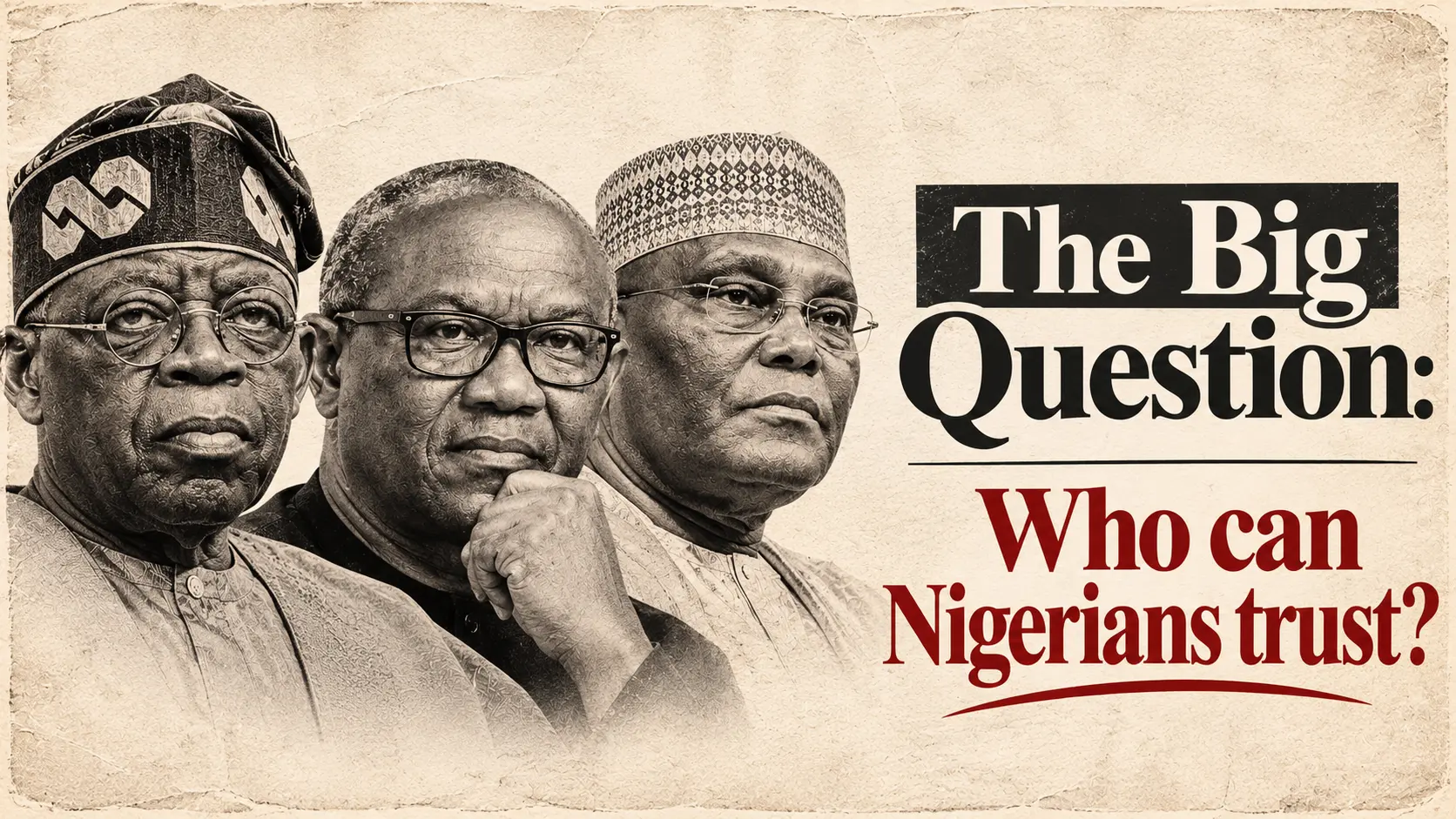
Among the politicians whose records deserve close examination are President Bola Ahmed Tinubu, former Vice-President Atiku Abubakar and former Anambra State governor Peter Obi.
Their political careers have been accompanied by controversies involving financial transactions, offshore companies, alleged conflicts of interest and questions about the management of public resources.
Some of these matters have been investigated by foreign authorities. Others have appeared in Nigerian court proceedings, investigative reports and official inquiries. In several instances, the politicians involved have denied wrongdoing or offered explanations for the transactions under scrutiny.
But what is established, what remains disputed, and what have the individuals themselves said?
This investigation examines the corruption allegations against Tinubu, Atiku and Peter Obi, drawing on publicly available court documents, official reports, financial investigations and statements from the politicians or their representatives.
1. Bola Ahmed Tinubu: The $460,000 Chicago forfeiture and the Alpha-Beta controversy
Two financial controversies stand out in the public record surrounding President Bola Ahmed Tinubu: a 1993 civil forfeiture proceeding in the United States and allegations involving Alpha-Beta Consulting, a company associated with Lagos State’s internally generated revenue collection.
The Chicago case: Why was $460,000 forfeited?
The controversy dates back to the early 1990s, long before Tinubu became governor of Lagos State.
In July 1993, the United States government filed a civil forfeiture complaint at the US District Court for the Northern District of Illinois. The proceedings concerned several bank accounts held in the name of Bola Tinubu and Compass Finance and Investment Company.
The US government alleged that funds in the accounts represented proceeds of narcotics trafficking or were involved in financial transactions connected to money laundering.
An affidavit submitted by IRS Special Agent Kevin Moss formed part of the government’s case. It described an investigation into a heroin distribution network operating in Chicago and identified financial transactions involving individuals connected to that investigation.
The affidavit also identified Tinubu’s banking relationship with Adegboyega Mueez Akande, an individual investigators linked to the alleged drug distribution network.
According to the affidavit, Tinubu opened accounts at First Heritage Bank in December 1989. Investigators subsequently examined deposits, transfers and other transactions involving the accounts.
The document stated that Tinubu’s account received an $80,000 wire transfer in January 1990. It also recorded other substantial deposits during 1990 and 1991.
The affidavit further stated that investigators contacted representatives of Mobil Oil, where Tinubu worked as a treasurer, and that the company confirmed his employment but said his position did not involve transferring large amounts of money between banking institutions.
These were allegations and investigative findings presented by US authorities in support of a civil forfeiture action, not findings from a criminal trial against Tinubu.
The case was eventually settled.
On September 15, 1993, the court approved a settlement order. Subsequently, on October 4, 1993, Judge John A. Nordberg ordered the forfeiture of $460,000 from an account held in Tinubu’s name at First Heritage Bank.
The court order stated that the funds represented proceeds of narcotics trafficking or were involved in financial transactions violating US money-laundering laws.
The money was forfeited to the United States government.
The distinction is important: the proceedings were civil forfeiture proceedings against assets. Tinubu was not criminally convicted in that case.
Tinubu’s response
In November 2022, Festus Keyamo, then spokesperson for the Tinubu-Shettima Presidential Campaign Council, addressed the controversy during an interview on Channels Television’s Politics Today.
Keyamo argued that the forfeited money represented unpaid taxes on investment earnings rather than proceeds of drug transactions.
He explained that Tinubu had maintained investment accounts in the United States and that the banks had failed to deduct the applicable taxes.
Keyamo said:
“The deposits he made there (in banks) are what bankers called investments; he kept the money there and he was getting interests.”
He further argued that the banks were expected to deduct the taxes at source and that the failure to do so was not deliberate on Tinubu’s part.
He also insisted that Tinubu had not been criminally indicted or convicted.
What the records establish
The $460,000 forfeiture is documented in the US court records. The government’s original complaint and affidavit also provide details of the investigation and the financial transactions that prompted the forfeiture.
However, the court proceeding did not produce a criminal conviction against Tinubu.
Keyamo’s explanation that the money represented tax deductions is the campaign’s account of the matter. It should be considered alongside the language of the court’s forfeiture order, which expressly described the funds as proceeds of narcotics trafficking or property involved in money laundering.
The public record therefore establishes both the forfeiture and the absence of a criminal conviction arising from that proceeding.
Sources:
- US District Court documents
- Channels Television: Keyamo’s explanation of the $460,000
- AFP Fact Check: What the Chicago case established
Alpha-Beta Consulting: The Lagos revenue collection controversy
Another financial controversy surrounding Tinubu emerged from the operations of Alpha-Beta Consulting, a company involved in Lagos State’s internally generated revenue collection and reconciliation system.
For years, Alpha-Beta occupied an important position in Lagos State’s revenue administration, reportedly earning commissions for its services.
The company’s relationship with the state attracted scrutiny because of the allegations that Tinubu, who governed Lagos from 1999 to 2007, exercised ownership or control over the business through proxies.
The controversy became particularly prominent in 2020 when Oladapo Apara, a former managing director of Alpha-Beta, accused the company and Tinubu of financial misconduct.
Apara alleged that Tinubu controlled the company through nominated associates and that more than ₦20 billion had been transferred from Alpha-Beta to private business accounts.
He also alleged that he was removed from his position after raising questions about the company’s finances.
In a separate aspect of the dispute, Apara claimed that he was owed substantial financial entitlements.
The allegations were taken to the Lagos State High Court.
Alpha-Beta’s response
The company rejected Apara’s accusations.
In October 2020, its managing director, Akin Doherty, issued a response accusing Apara of financial impropriety.
Alpha-Beta alleged that Apara had diverted approximately ₦6 billion from the company and had inflated a contract worth approximately $300,000, diverting the resulting funds.
The company also claimed to have reported the alleged misconduct to the relevant authorities.
These counter-allegations were not proof that Apara committed the offences alleged, just as Apara’s accusations did not establish that Tinubu controlled the company or ordered the transfers.
How did the dispute end?
In January 2022, lawyers representing Apara informed the Lagos State High Court that the parties had begun discussions towards an out-of-court settlement.
The proceedings were subsequently withdrawn following a settlement.
The Africa Report later reported in September 2022 that the settlement had been reached and that the EFCC had dropped its probe into Tinubu in connection with the dispute.
The terms of the settlement were not publicly disclosed in the reporting examined.
This leaves important questions about the company’s ownership structure, the value of its commissions over the years and the financial allegations made by both parties.
A dispute being settled outside court does not establish the truth of either side’s allegations.
Sources:
- Punch: Alpha-Beta responds to Apara’s allegations
- QED: Tinubu and Alpha-Beta former MD discuss settlement
- The Africa Report: Alpha-Beta dispute and settlement
2. Peter Obi: The Pandora Papers, offshore companies and questions about asset declarations
Peter Obi built much of his political reputation around prudent financial management, transparency and the responsible use of public resources.
However, his name appeared in the 2021 Pandora Papers investigation, a global journalistic project that examined how wealthy individuals and politically exposed persons used offshore companies and financial structures to hold assets.
The investigation was coordinated by the International Consortium of Investigative Journalists (ICIJ), with Premium Times participating as its Nigerian media partner.
The revelations raised questions about Obi’s offshore business interests during his time as governor of Anambra State.
NEXT International and the offshore holdings
One of the major findings concerned NEXT International (UK) Limited, a British company associated with Obi.
The investigation reported that Obi remained a director of the company for approximately 14 months after becoming governor in March 2006.
The reporting also examined his interests in offshore companies, including Gabriella Investments Limited, incorporated in the British Virgin Islands.
The central issue was not simply that Obi had offshore investments.
Nigeria’s constitutional Code of Conduct provisions place restrictions on public officers engaging in private business while in office, subject to specified exceptions.
Public officers are also required to declare their assets and liabilities. The rules restrict the operation of foreign bank accounts by public officers.
The Pandora Papers findings therefore raised questions about whether Obi’s corporate interests, directorships and foreign accounts were properly disclosed and whether his activities complied with the rules governing public office.
Obi’s response: ‘I am not guilty as charged’
Obi publicly rejected the suggestion that his offshore investments amounted to corruption or money laundering.
During an appearance on Arise Television’s The Morning Show in October 2021, he argued that the companies were legitimate investment structures used for family investments, savings and estate planning.
He said:
“I am not guilty as charged. Trust companies are a legitimate vehicle used everywhere globally for investments, savings and estate planning purposes. It’s allowed by law everywhere.”
He also addressed the allegation that the companies were used to launder public money.
“The company was never used to launder money before, during and after I was governor.”
Obi maintained that his investments were legitimate and that he had relied on professional advice from bankers and legal practitioners.
He also explained how he accumulated his wealth before entering politics, pointing to his business activities, imports, investments and involvement in banking.
On the question of his asset declarations, Obi’s position was that the investments were jointly held with members of his family and that he had acted on professional advice concerning their declaration.
His defence raises an important distinction: owning an offshore company is not automatically illegal. The relevant question is whether the ownership, directorships, bank accounts and associated interests complied with the laws governing public officers.
The EFCC and the subsequent CCB investigation
Following the Pandora Papers revelations, reports emerged that the EFCC had invited Obi for questioning.
In October 2021, his spokesman, Valentine Obienyem, said Obi had not received the invitation.
The spokesman explained that the letter might have been delivered to an old office address.
In a statement reported by TheCable and Punch, Obi’s position was:
“Obi, being a law-abiding Nigerian, will honour all legitimate invitations from government agencies at all times.”
The matter resurfaced in October 2026 when Premium Times reported that the Code of Conduct Bureau had opened an investigation into seven individuals named in the Panama Papers and Pandora Papers investigations, including Obi.
According to the report, the investigation concerns alleged undeclared offshore assets and business interests.
The CCB reportedly confirmed that it was examining the information and materials relating to the individuals.
As of the reporting examined for this article, no final finding of guilt against Obi had been announced in connection with this investigation.
What remains unresolved?
The public record raises several questions:
- Were all of Obi’s offshore interests properly declared?
- Did he comply with the restrictions on directorships and private business activities while governor?
- Were the relevant foreign accounts declared in accordance with the law?
- What has the CCB established through its investigation?
- Will the public eventually see the findings?
The investigation must distinguish between legitimate offshore investment arrangements and possible breaches of public-office regulations.
Sources:
- Premium Times: CCB investigates Obi and other public officials
- TheCable: Obi’s response to the Pandora Papers
- Pulse: Peter Obi explains his offshore investments
- Punch: Obi’s response to the EFCC invitation
3. Atiku Abubakar: The US Senate investigation, Siemens payments and PTDF funds
Of the three politicians examined in this investigation, Atiku Abubakar has been linked to several international financial investigations involving offshore companies, banking transactions and allegations of improper payments.
Two major areas deserve particular attention: the US Senate investigation into financial transactions involving his former wife, Jennifer Douglas, and the controversy surrounding the Petroleum Technology Development Fund during his tenure as vice-president.
A more recent development involving the Mambilla Hydroelectric Power Project has also brought renewed attention to a payment made to Douglas in 2003.
The US Senate investigation: More than $40 million in suspicious funds
On February 4, 2010, the US Senate Permanent Subcommittee on Investigations published a report examining how foreign politically exposed persons used offshore companies, trusts, lawyers and financial institutions to move money into the United States.
One of its case studies concerned Atiku and his then-wife, Jennifer Douglas.
The report examined transactions between 2000 and 2008 and identified more than $40 million in funds it described as suspect, transferred into the United States through offshore corporate structures associated with Douglas and Atiku.
Approximately $25 million was transferred into more than 30 US bank accounts opened by Douglas.
The report identified offshore entities including LetsGo Ltd, Guernsey Trust Company Nigeria Ltd and Sima Holding Ltd.
It also examined approximately $14 million transferred to American University-related accounts over five years in connection with consulting services associated with the development of the American University of Nigeria, founded by Atiku.
The investigators raised questions about the sources of the funds, the use of offshore companies and the failure of several financial institutions to properly identify Douglas as a politically exposed person.
The report did not establish that every dollar transferred was stolen public money. Its concern was the movement of suspicious funds through financial institutions and the weaknesses in the controls that should have identified and examined such transactions.
The Siemens connection
The Siemens bribery scandal added another dimension to the investigation.
The US Securities and Exchange Commission alleged that Siemens paid bribes to secure telecommunications contracts in Nigeria.
According to the 2010 Senate report and subsequent investigations, payments connected to the alleged bribery scheme passed through accounts associated with Douglas.
The Senate report identified approximately $1.7 million in Siemens-related payments to accounts associated with her.
A later Premium Times investigation reported that approximately $2.8 million in alleged bribe payments connected to Nigerian telecommunications projects was routed through an account held in Douglas’ name.
The SEC’s case against Siemens concerned fictitious consultancy arrangements allegedly used to facilitate payments to public officials.
Siemens admitted to widespread bribery and agreed to pay approximately $1.6 billion in penalties to US and German authorities in 2008.
It is important, however, to distinguish the company’s established bribery violations from the question of Atiku’s personal criminal liability.
The existence of payments into accounts associated with his then-wife, and their examination by US investigators, does not by itself establish that Atiku personally received bribes or was convicted of corruption.
The PTDF controversy: Allegations involving $20 million
Atiku’s financial controversies were not limited to international transactions.
During his time as vice-president under President Olusegun Obasanjo, he supervised the Petroleum Technology Development Fund.
In 2006, the EFCC conducted an investigation into the management and placement of PTDF funds.
A forensic investigation examined the release and placement of approximately $125 million approved for the fund and a subsequent $20 million transaction involving Trans International Bank.
According to the report, Atiku approved the release of $20 million without the required appropriation and Federal Executive Council approval.
The investigators described the action as improper and an abuse of office.
The report also raised questions about why PTDF funds intended for development projects had been placed in banks rather than immediately applied to the projects for which they were approved.
The Bayo Ojo administrative panel, established by then-President Obasanjo to examine the EFCC report, also criticised the handling of the funds.
The panel concluded that Atiku’s actions had benefited private business interests and associates rather than the public interest.
It specifically questioned his explanation that the earlier approval of $125 million covered the subsequent $20 million transfer.
The panel described that explanation as untenable.
This is a significant public-finance controversy because it concerns decisions taken by a serving vice-president over funds allocated for a public development purpose.
What did Atiku say?
The 2006 inquiry examined Atiku’s explanation that the broader approval for the original $125 million covered the subsequent transaction.
That explanation was rejected by the Bayo Ojo panel.
In September 2006, the conflict between Obasanjo and Atiku became increasingly public, with both camps releasing financial documents and accusing each other of benefiting from PTDF funds.
Atiku’s office also released cheques and other documents purporting to show that Obasanjo had benefited from PTDF-related funds.
The political confrontation became a dispute involving allegations and counter-allegations at the highest levels of government.
For this article, the panel’s findings must be distinguished from a criminal conviction. The publicly available material examined does not establish a final criminal conviction of Atiku arising from the $20 million PTDF transaction.
The Mambilla development: A $500,000 payment
In September 2026, another development brought Atiku’s financial history back into public discussion.
An International Chamber of Commerce arbitration tribunal in Paris issued a final award concerning the dispute between Sunrise Power and the Nigerian government over the Mambilla Hydroelectric Power Project.
The award examined a $500,000 payment made by Leno Adesanya, the promoter of Sunrise Power, to an account belonging to Jennifer Douglas in January 2003.
The payment was made from an offshore company account associated with Adesanya.
The tribunal examined the circumstances surrounding the transaction and raised concerns about the explanation offered for it.
According to the tribunal’s findings reported by Premium Times, Adesanya failed to provide documentary or independent witness evidence supporting his explanation that the payment represented a legitimate foreign-exchange transaction.
The tribunal described the payment as raising significant red flags.
The payment was particularly sensitive because it occurred while Atiku was vice-president and at a time when the Mambilla project was being processed.
However, the arbitration was not a criminal trial of Atiku.
Atiku’s response
Atiku rejected suggestions that the arbitration tribunal had found him guilty of corruption.
In a statement issued through his Senior Special Assistant on Public Communication, Phrank Shaibu, he challenged the APC to produce the portion of the award establishing that he received a bribe or influenced the contract award.
He maintained that he was not a member of the procurement panel that awarded the Mambilla contract.
Atiku’s position was that the tribunal’s examination of the payment did not amount to a finding that he had received a bribe or participated in a corrupt conspiracy.
His response addresses the allegation of personal criminal wrongdoing, although it does not by itself resolve the questions surrounding the payment to his former wife.
Sources:
- Original US Senate report
- Premium Times: Five international financial controversies involving Atiku and his former wife
- Premium Times: Mambilla payment and ICC tribunal findings
- TheCable: Atiku’s response to the Mambilla allegations
- AFP: Clarification of the 2010 US Senate report
4. What the records tell us, and what they do not
Examining these three political figures side by side reveals different types of financial controversies.
Tinubu’s record includes a documented US civil forfeiture involving $460,000 and allegations concerning the operations and ownership of Alpha-Beta Consulting.
Obi’s record includes offshore corporate interests and questions about asset declarations and compliance with the restrictions governing public officers.
Atiku’s record includes an extensive US Senate investigation into financial transactions involving his former wife, allegations surrounding Siemens-related payments, the PTDF financial controversy and the more recent Mambilla payment.
These matters are not identical, and they should not be treated as though they carry the same legal or evidentiary weight.
A court forfeiture order, an investigative report, an administrative panel’s findings, a financial intelligence report and an ongoing regulatory investigation are different forms of evidence.
They must be assessed accordingly.
| Politician | Major public-record controversy | Established position |
|---|---|---|
| Bola Tinubu | Chicago forfeiture | $460,000 was forfeited under a civil court order; no criminal conviction in that case |
| Bola Tinubu | Alpha-Beta Consulting | Serious allegations and counter-allegations; dispute settled out of court |
| Peter Obi | Pandora Papers | Offshore interests and directorships raised questions about public-office obligations |
| Peter Obi | CCB investigation | Investigation reported in October 2026; no final finding of guilt established |
| Atiku Abubakar | US Senate report | More than $40 million in suspect funds examined; no criminal charges arising from the report established |
| Atiku Abubakar | PTDF | EFCC forensic report and administrative panel criticised financial decisions; no final criminal conviction established here |
| Atiku Abubakar | Mambilla payment | $500,000 payment to his then-wife examined by an arbitration tribunal; Atiku denies wrongdoing |
5. The question Nigerians must ask
The purpose of examining these records is not to declare one politician guilty and another innocent.
It is to establish what the public knows about the people who have governed, influenced government decisions or are seeking another opportunity to exercise political power.
Nigerians deserve to know how their leaders accumulated wealth, whether their business interests were properly declared, how public resources were managed and whether allegations involving public money were adequately investigated.
A politician’s denial deserves to be heard. But a denial should not replace an independent examination of the evidence.
Equally, an allegation should not become a conviction simply because it has been repeated for years.
There is a difference between being investigated, being accused, being found responsible by an administrative panel and being convicted by a court.
Voters must understand those differences.
Ultimately, the question is not merely which politician has the fewest controversies. It is whether the people seeking power can provide convincing explanations for the financial questions surrounding their public lives.
Nigeria has heard enough promises about fighting corruption.
The country deserves leaders who can withstand scrutiny, account for their decisions and demonstrate that public office is a responsibility rather than an opportunity for private enrichment.