

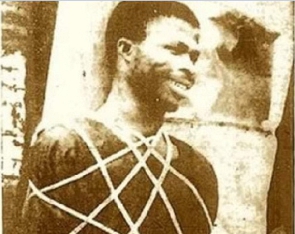
.
“Doctor Oyenusi”, A Notorious Nigerian Armed Robber, who terrorized the people of Lagos and neighbouring cities in the 1970s.
Notorious Armed Robber, Ishola Oyenusihos highly skilled in snatching cars,robbing banks, factories and killing people with his gang of six
His Early Life
No one knew much about his childhood, but he was a boy born into poverty, beaten down by a system that offered little to the poor but hardship.
Ishola Oyenusi dreams of becoming something more—perhaps a scholar, perhaps just a man of means—were shattered when his family could no longer afford his school fees
Dr Oyenusi, as he was called, the Notorious Armed Robber was not a doctor by profession but adopted the title for fun.
The evidence lies in a confession he made just minutes before his execution
Without a secondary school education, Oyenusi could in no way have been a medical doctor
His Criminal Journey
Ishola criminal journey began, as many tragic stories do, with love—or something like it.
He stole a car to impress a girlfriend, killing the owner in cold blood.
The sold the stolen vehicle for a paltry ₦400, the blood money handed over as a twisted token of affection
They called themselves the Dangerous Seven—and they lived up to the name.
Banks, highways, and government convoys became their playgrounds. Lagos trembled at the mention of them.
Unlike common thieves who crept in the dark, Oyenusi struck in broad daylight, dressed to kill—literally.
He wore sunglasses, three-piece suits, and an arrogance that bordered on madness. To some, he was a rebel.
He came into the limelight after the Nigerian Civil War ended in 1970.
He robbed banks and individuals both in daylight and at night, and he never let any of his victims live to see another day, he killed them all.
This earned him the nickname “Doctor Rob and Kill.”
At the height of his horrific reign, Ishola Oyenusi bragged that the bullet has no power.
He probably forgot that he who lives by the sword will surely die by the sword.
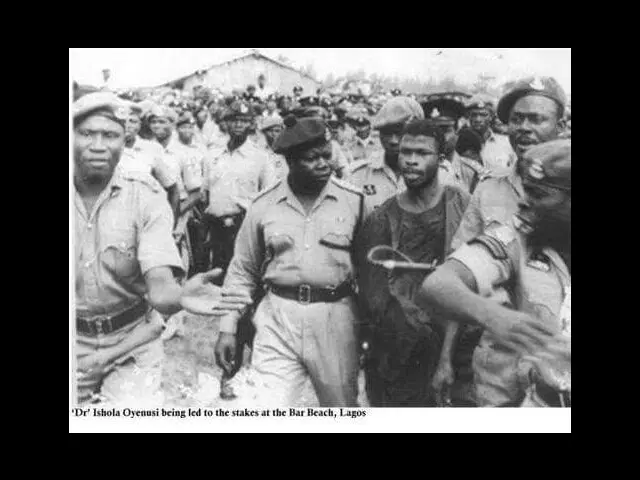
His Execution
However, nothing lasts forever. As the Yoruba adage says, every day belongs to the thief, but a day belongs to the owner.
The police nabbed Oyenusi during one of his robbery operations on March 27, 1971, in which he and his notorious gang killed a police constable named Mr. Nwi and stole $28,000.
His associate, Joel Amamieye, famously declared before his execution:
“I have no regrets for stealing from the rich and giving to the poor. I am proud of what I did.
But to most Nigerians, Oyenusi was a symbol of everything broken in their society. A walking nightmare.

A man whose rise revealed just how far the rule of law had fallen.
His reign came to an end on March 27, 1971.A police Officer was shot and killed in during a failed robbery attemp. That murder broke the dam.
Security forces, already under pressure from a terrified public and a jittery military government, swooped in.
Oyenusi was arrested, with his men. The trial was fast, brutal, and symbolic.
Justice wasn’t served behind closed doors in those days, It was a public event
“Doctor” Ishola Oyenusi was clouded with shame as he was brought before the law, found guilty, and sentenced to death by firing squad.
He confessed that he was not to die alone because he had not committed the crimes alone.
He revealed the names of other members of the gang, including,
Joseph Osamedike, Ambrose Nwokobia, Joel Amamieye, Philip Ogbolumain, Ademola Adegbitan, and Stephen Ndubuokwu.
Over 30,000 people were present when Oyenusi was ushered to the popular Bar in Lagos for his execution,
Some civil servants even brought a coffin to the execution ground to mock the once-mighty robber kingpin. who was now nothing more than a scapegoat whose last breath could be taken at any moment.
Oyenusi Smile To His Death
He was sweating profusely but managed to smile all the way to the stakes.
He kept smiling, smiling, and smiling, but could not hide the agony and terror clearly written on his face.
The soldiers lined up and aimed their ever-ready guns.
Some of the criminals shouted their last words of protest at the cameras. When a loud voice called out, “Fire!” Oyenusi and the other criminals’ bodies were riddled with bullets.
That was the bitter end of Ishola Oyenusi, who lived by the bullets and died by the bullets.
His execution sent the streets of Lagos into a deserted silence at night, as families locked themselves behind doors for fear that some of Oyenusi’s gang members might retaliat


