

Nigeria has maintained its position as the fourth largest economy in Africa following a major rebasing of its gross domestic product (GDP), despite hopes that updated figures might lift the country higher in the continental rankings.
The National Bureau of Statistics (NBS) reported that Nigeria’s economy expanded to N372.8 trillion ($243bn) in 2024, up from N314.02 trillion the previous year.
The growth reflects a broader assessment of economic activity, especially within the informal sector, and updates the GDP base year from 2010 to 2019.
The rebasing, covering the period from 2019 to 2023, aimed to better reflect shifts in the structure of Nigeria’s economy and incorporate improved data sources.
Yet despite the adjustments, the country failed to reclaim its position as Africa’s top economy.
Nigeria lags behind South Africa, Egypt and Algeria
According to the IMF, South Africa remains the continent’s largest economy with a GDP of $410.34bn, even though its population is roughly one-quarter the size of Nigeria’s.
Egypt ranks second at $347bn, followed by Algeria at $268.9bn.
In contrast, Nigeria’s rebased GDP—though 30 percent higher than the IMF’s earlier 2024 projection of $188bn—was still not enough to move the country up the ladder.
Services sector powers Q1 2025 growth
For the first quarter in the year 2025, the Nigeria’s economy recorded 3.13 percent year growth, it’s up from 2.27 percent in Q1 2024.
This performance was greatly influenced by the services sector, which also contributed a substantial 57.5 percent to total GDP
However, on a quarterly basis, growth contracted slightly by 0.63 percentage points.
According to the NBA, the quarterly revised estimates have been aligned with the new base year in other to ensure consistency between the past and current GDP series
This sectoral breakdown showed the growing industry sector by 3.42 percent, while agriculture managed a modest 0.07 percent uptick
‘In terms of share of the GDP, the services and industry sectors contributed more to the aggregate GDP in Q1 2025 compared to the corresponding quarter of 2024,’ the NBS said.
Nominal GDP hits N94 trillion in Q1 2025
The Nominal GDP in basic prices for Q1 2025 stood at N94 trillion, compared to the same quarter of 2024, which is N79 trillion marking an 18.3 percent increase year by year
The updated figures has offered policymakers a more accurate snapshot of economic performance, and it has also revived debate about whether statistical updates alone can improve Nigeria’s economic standing.
The Structure that Lags beyond the numbers
The rebasing has expanded the size of Nigeria’s economy on paper, but the analysts has caution that this does not resolve core structural issues.
The informal economy remains dominant, the productive gains are uneven, and also the real sector reforms continue to lag
Observers also suggested that meaningful advancement in Africa’s GDP will require more than just statistical revision.
It will required investment, diversification, and also sustainable economic transformation
As of early 2026, Nigeria’s economic ranking in Africa has stabilized at 5th place, according to IMF projections.
It fell low to 4th place in 2024 and 201t die to massive currency devaluation, which dropped behind Algeria for a period.
Which later hit 5th place in major GDP rankings.
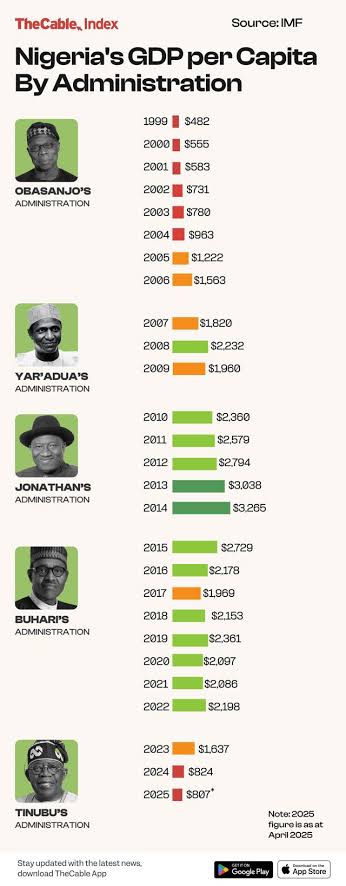
The impact of this economic volatility On Nigeria in “Tinubu-era”
The impact of this economic volatility and the accompanying “Tinubu-era” reforms on Nigeria as a nation has been profound, they include:
Severe Socio-Economic Hardship And Poverty Surge
2026 projections indicate that 52% of Nigerians ( about 141 million people) may be living in severe poverty
The Cost Of Living
The inflation is projected to drop to about 13%-16% by late 2026, the high cost of transportation, food, am fuel, which is as a result of 2023 subsidy removal as continued to erode household purchasing power
Investment Shifts and Business Environment
The high operational costs and foreign exchange (FX) volatility as led to the exit of major global firms such as Procter and Gamble, Sanofi, and GSK which shifted from the local manufacturing to import only models
Quality Investment
The Foreign Investment (FDI) as remained subdued as investors favors short-term and high yielding financial instruments, like Treasury bills, over long-term productive investment in manufacturing.
Brain Drain “Japa Syndrome”
Instability in economy has accelerated the Japa Syndrome, where highly skilled and professionals in ICT, engineering, healthcare emigrate for better opportunities and greener pastures, leaving the domestic workforce unattended to.
Crisis In Health Sector
Over 17,000 doctors have emigrated, which has severely impacted patient care, leading to longer wait times and a failing doctor to patients care.
Social Trust Deficit
There is a significant trust issues between the citizens and the Government, who feel the burden of reform but seeing little change in high political class.
Insecurity
The ongoing inspection the country remains a “macroeconomics risk” , as it has continued to crippled farming communities and it also contributed to discouraging regional investments, which has led to food inflation
Conclusion
The brief descent to 4th and 5th place, has mirrored the end of Nigeria’s decade long reign as the largest economy owner in the continent, a title which was lost primarily to massive currency devaluation
Perhaps more damaging than GDP rankings is the drop to 18th place in continental investment attractiveness, suggesting that international capital no longer views Nigeria as a primary frontier market.
While the subsidy removal and Naira unification were extended to fix fiscal imbalances in a “shrunken” economy in terms of dollars and a cost of living Crisis that has fundamentally altered the country.


