
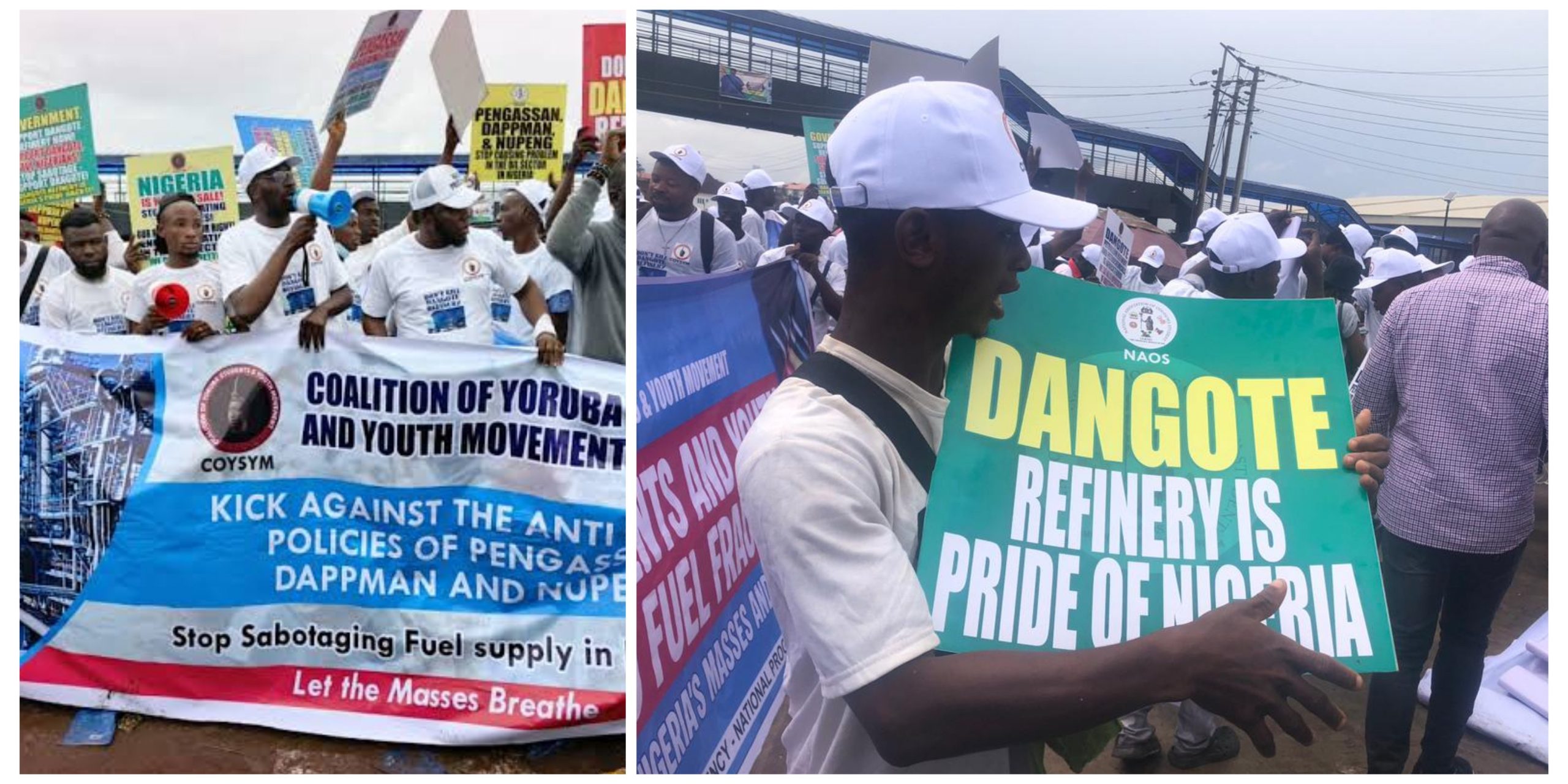
The Education Rights Campaign (ERC), Oyo State Chapter, has condemned a recent protest by the National Association of Oduduwa Students (NAOS) in support of the Dangote Refinery’s management.
The protest was held in Ibadan on October 7, 2025, to express solidarity with the refinery following its dispute with the Nigeria Union of Petroleum and Natural Gas Workers (NUPENG) and the Petroleum and Natural Gas Senior Staff Association of Nigeria (PENGASSAN) over the dismissal of 800 workers for joining trade unions.
However, in a statement in reaction to the protest on Friday, the ERC described the protest as a “misplaced priority” and a “regrettable diversion” from the pressing issues affecting Nigerian students and the broader struggle for educational rights.
“It’s both perplexing and disappointing that a student body would choose to rally in defense of a private company’s anti-worker policy rather than stand up for students’ rights and welfare,” the ERC stated in the statement signed by its State Coordinator, Nnamdi Ochi.
The ERC highlighted the pressing issues facing Nigerian students, including skyrocketing tuition fees, inadequate accommodation, and outdated facilities.
It noted that instead, the students’ group should channel their energy towards genuine struggles that truly affect their lives, such as resisting school fee hikes and fighting for independent students‘ unionism.
The educational group stated that this time that Universities in Nigeria are faced with imminent shutdown due to looming strike, students should be mobilize in defense of affordable and quality education and not for coperate interess.
At a time when universities across the country face imminent shutdowns due to looming strikes by both academic and non-academic staff — a result of chronic underfunding by state and federal governments — students should be mobilising in defence of affordable and quality education, not corporate interests.
These funding crises have led to a wave of skyrocketing tuition fees, pushing the cost of education beyond the reach of ordinary families.
“For instance, at the Ladoke Akintola University of Technology (LAUTECH), Ogbomoso, and Osun State University, tuition fees now range between N320,000 and N790,000, and N350,000 and N1.3 million, respectively, depending on the course of study.
Even federal institutions like the University of Ibadan are not exempt from this trend.
They also added the issue of students in UI that faces displinary committee just for participating in anti fee hike protest
Currently, two UI students are serving suspensions of four academic semesters each, with another still facing trial — all for participating in anti-fee hike protests.
Unfortunately, these exorbitant fees have not translated into improved learning conditions.

Accommodation remains inadequate, facilities are outdated, and the general state of infrastructure in many institutions is deplorable.”
Given these harsh realities, the ERC finds it both disturbing and unfortunate that NAOS would expend its energy on a cause that neither reflects the struggles of students nor advances the fight for adequate funding of public education.
Even worse, the protest promoted an anti-worker agenda, thereby undermining workers’ legitimate right to unionise — a position the ERC categorically condemns,” the statement noted.
The ERC also criticised the NAOS protest for promoting an anti-worker agenda and undermining workers’ legitimate right to unionize.
“The persistent hike in fuel prices stems from neoliberal policies of deregulation and privatization, which prioritize profit over the welfare of ordinary Nigerians,” the ERC noted.
The ERC urged Nigerian students and progressive student organisations not to be manipulated into defending corporate or anti-worker interests disguised as patriotic causes.
“Students must reject all attempts to divert attention from these legitimate struggles or to criminalise workers’ rights to organise and unionise, and rather express solidarity with workers in their demand for justice and union freedom,” the statement noted.
It added, “It is false to present the Dangote Refinery as a national asset serving the collective interest of Nigerians.
In reality, it is a private capitalist enterprise, driven by profit, not public welfare. Equally misleading is the attempt to blame trade unions for the high cost of fuel and gas.
Such narratives only serve to shield corporate interests while diverting public attention from the true causes of hardship in the oil sector.”