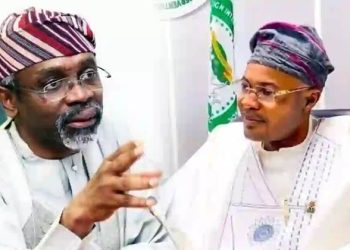

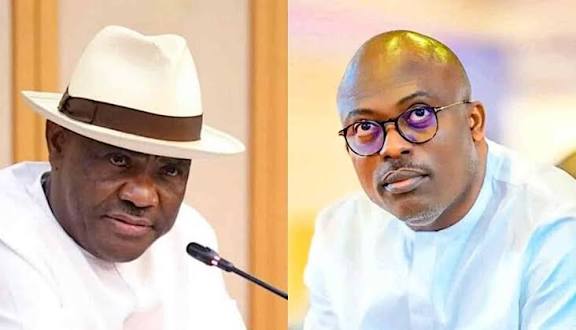
The ongoing political dispute between Nyesom Wike, The Minister of the Federal Capital Territory, who was also former two-term Governor of River State, and Siminalayi Fubara, the incumbent Governor of the state, as become one of the most polarizing political feud in contemporary Politics in Nigeria today
The conflict has exposed the deep structural tension of godfather-ism, not only in River State but in Nigeria as a whole.
Where some political elders and patron attempts to control their protege, before and even after elections, undermining the place of democracy in governance and autonomy of an institution.
The Origin of the Dispute
Wike was one of the instruments that made Fubara to rise to Governorship in 2023.
As one of the powerful political bosses in River State, His support was pivotal in shaping who succeeded him in the state.
Many elder in different political parties also believed that Fubara emerged as Governor largely due to Wike’s support, influence and political machinery.
However, not long after Fubara assumed office in May 29, 2023, the said relationship between the godfather and godson started to publicly deteriorate.
What was seen to be partnership quickly transferred to deep mistrust and public rivalry.
The root of the disagreement centered on control of the political structure of the state, including state resources, loyalty of the lawmakers and also broader direction of governance in Nigeria’s oil-rich state.
In months, the tension escalated into open factionalism within the Rivers State House of Assembly, where Wike loyalist clashed interest with Governor Fubara loyalist.
Even in late 2023 the Assembly itself was found amid impeachment rumors, this was an indicator how far the dispute had escalated.
Dispute Escalation and Legal Battles
Throughout year 2024 and 2025, the disagreement took different but dramatic turn.
Loyalists of Wike among the lawmakers led by Speaker Martin Amaewhule attempted to undermine Fubara authority by blocking his budget presentation and also threatened him with impeachment.
Wike boldly supported the idea by saying he wouldn’t stop the constitutional process, even if it later led to real impeachment, later in early 2025.
The Supreme Court ruled out a suit filed by Fubara against 27 Pro-Wike lawmakers, leading to a legal blow to the governor’s efforts to rein in the legislature.
However, many peace-making meetings were held, which included a publicised reconciliation meeting in June 2025 at the President’s Villa in Abuja, where President Bola Tinubu and the former President publicly reconciled and stated that they would work together.
Though this claimed peace look fragile as underlying mistrust persisted and soon resurfaced.
Current Escalation
As early as this 2026 is, the rivalry has reignited with force and intensity. Nyesom Wike has openly berated Siminalayi Fubara.
He accused him of reversing some programs he initiated, such as employment of 10,000 youths and also labeled him as ‘ bad child‘ for disloyalty.
This has extended to national Party politics.
Wike has also dismissed the claim that Fubara is the leader of the Rivers APC faction.
This has also spilled to internal APC political dynamics, which has led to made figures like APC leader, Basiru clashing with FCT minister, Wike over Fubara’s second term.
Also, The Rivers State Assembly has also barred Fubara from presenting the 2026 budget amid impeachment probes.
While some leaders in APC and some youth in Rivers State are urging President Bola Tinubu to remove Wike as FCT Minister, illustrating how the local feud has turned to national dispute.
The Root Cause of Godfatherism and Power Politics
The sole cause of Godfatherism in Rivers State is to gain control of Enormous State Resources.
Rivers State is one of Nigeria’s wealthiest states due to, Oil revenue and derivation funds.
Also Large federal allocation. Wealth that comes from political offices ads extremely attractive.
Political godfathers invest heavily in elections with the expectation of controlling access to state resources once their candidate wins.
Godfatherism thrives where political office guarantees access to wealth
Godfatherism has also rooted in personal loyalty rather than merit.
Candidates are often selected not because they are the most capable, but because they are perceived as loyal
However, once in office, governors often seek independence, leading to inevitable conflict with their godfathers — as seen in the Wike–Fubara dispute.
Rather than leaving Fubara as an autonomous Governor, Wike continued to influence and make demands which has fueled resentment, resistance and also a struggle for institutional autonomy.
Some analyst has argued that this situation reflects a broader problem in Nigerian politics, where political sees less about policy continuity or the choice of the people, but more about maintaining influences and some networks.
How Wike- Fubara Dispute can Affects the Citizens of Rivers State
The prolonged political battle between the former and current governors has repeatedly stalled government activities.
Budget presentations have been blocked, legislative sessions disrupted, and executive-legislative relations severely damaged.
In the other hand, for ordinary Rivers State residents and citizens, it can cause salaries and pension delay for civil servants, infrastructure projects can be stalled
Poor implementation of education, health and social programmes.
When political leaders are locked in power struggles, citizens bear the cost through slow or non-existent service delivery.
Also for the legislative, the state House of Assembly has been deeply divided along loyalty lines.
This instability weakens its constitutional role of law-making and oversight.
As a result, laws that should improve lives are delayed or abandoned
Government policies lack consistency
For small business owners, civil servants and investors, uncertainty discourages economic activity and job creation.
Rivers State is an oil-producing and commercially strategic state, this dispute can lead economic unsustainability.
Reduced private investment and slow business expansion
When politics overshadow governance the economic growth suffers, which can be felt by the citizens through unemployment and hardship
It can also lead to threat to peace and security.
The crisis has already sparked protests, tension, and destruction of public property, including the burning of the State Assembly complex.
Rivers State has a history of political violence, and prolonged elite conflicts raise concerns about renewed instability.
Mixed Reactions has spread widely, Some people see Wike’s actions as necessary oversight, by holding the government accountable and also fighting for the interests of Rivers people.
Others also see the fued as unnecessary and petty, warning against inherent threats to peace and order of democracy.
Even among national political parties, the dispute has drawn different reactions from party leader, pressure groups, civil society, masses and even some other governors backing Fubara for Wike’s external intervention.
Also, Nyesom Wike has Vowed to block Siminalayi Fubara ahead of 2027 elections for his second term
Conclusion
The Wike-Fubara disagreement turned feud is far from a simple clash of personality.
It has become symbolic of the place of godfatherism in Nigerian democracy.
As both state men jockey for influence ahead of the 2027 elections.
The long dated feud and crisis in Rivers State serve as a reminder that authentic democratic governance requires that political leaders should be accountable to institutions and citizens, not just to parade as political patrons.